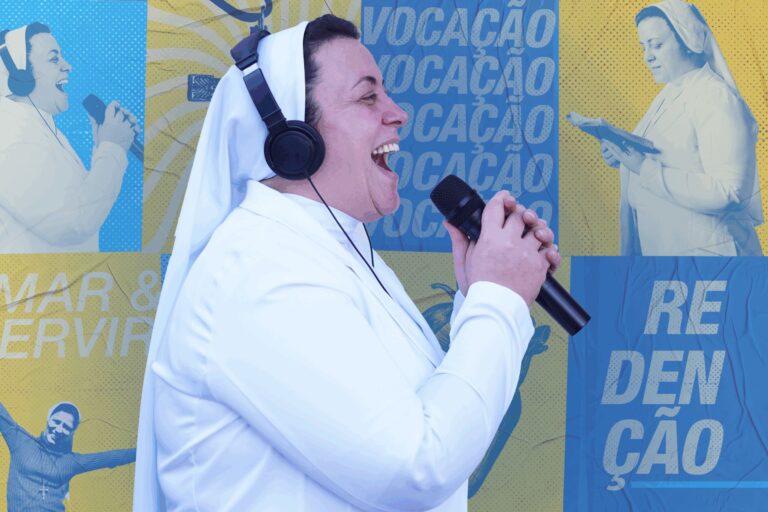
A video of Brazilian nuns beatboxing and dancing hip-hop, a scene taken from a local TV show and defined by celebrities like Whoopi Goldberg as “a real life ‘Sister Act,'” went viral May 28, with millions of views all over the world.
Sisters Marizele Isabel Cassiano Rego, 46, and Marisa de Paula Neves, 41, were taking part May 20 in a TV show of the Catholic network Pai Eterno (Eternal Father), in Goiás state, in order to talk about a vocational encounter the two were attending in the region.
As they mentioned their artistic ways of reaching the youth, they presented a song they wrote about God’s calling. Sister Marizele sang it and Sister Marisa began to dance — the whole act had a noticeable hip-hop nature. That’s when Sister Marizele began beatboxing.
The short clip went viral on social media and was reproduced by international news agencies May 28. Actress Viola Davis shared it on her Instagram account, mentioning Sister Mary Clarence, Whoopi Goldberg’s character in the 1992 movie “Sister Act.”
On ABC’s “The View,” Goldberg commented on the clip, saying that “anytime you can praise the Lord with some music and you’re doing your thing, I think it’s a good sign.”
Sister Marizele and Sister Marisa are members of the Brazilian congregation of the Sisters of the Copious Redemption, created in 1989 by Redemptorist Father Wilton Lopes in the city of Ponta Grossa, Paraná state, where both of the sisters live today. Their mission is to work especially on the rehabilitation of drug addicts.
Father Lopes received a revelation in 1991, after which it was decided that every day each sister would pray for drug or alcohol addicts in front of the Blessed Sacrament.
“I’ve learned how to sing with my family. My grandfather was a player of Caipira guitar,” Sister Marizele told OSV News, mentioning a 10-string guitar developed in the colonial era in São Paulo state — traditionally used for playing rhythms from the countryside.
At home, she and her sisters would promote karaoke nights. Since her teens, she has been experimenting with mouth sounds as well.
“I’ve never had the opportunity to formally learn beatboxing, but somehow I managed to develop my own way of doing it. Experts told me it’s pretty fine,” said Sister Marizele.
As a young participant of Catholic charismatic renewal groups, she began singing at church before joining the congregation 21 years ago.
“In order to evangelize drug addicts, we would resort to beatboxing, dance, music, theater. We need to be rather creative,” described Sister Marizele, who has lived for nine years in therapeutic communities.
The impact of such artistic activities in the sisters’ missionary work has been noticeable, they said.
Quinton Thomas first seminarian ordained from Jonesboro
written by Katie Zakrzewski |
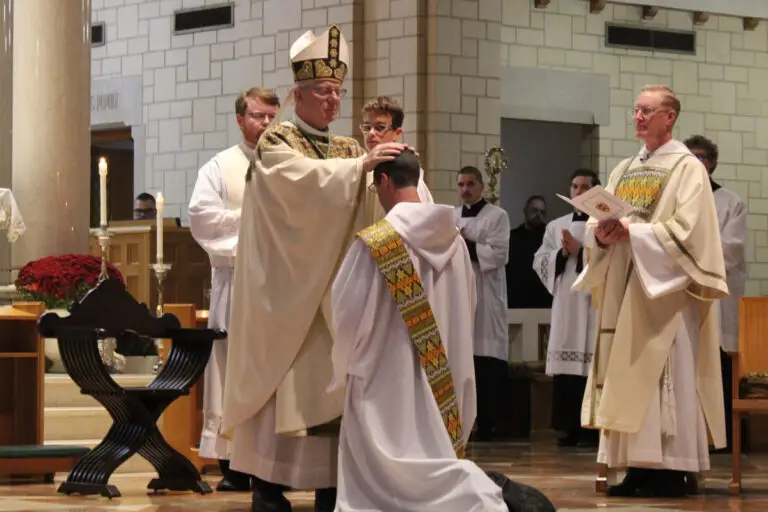
More than 500 lay Catholics, clergy and men and women religious packed into every available space at Blessed Sacrament Church in Jonesboro May 13 to watch seminarian Quinton Thomas be ordained a transitional deacon.
With this Mass and celebration, Thomas is one step closer to becoming a priest.
For as long as he can remember, Thomas has felt a call to the priesthood.
“I don’t remember learning that there was a God. I think by grace, by providence, I kind of knew that there was a God from very early on,” Thomas told Arkansas Catholic.
Thomas’ mother and his devout Catholic grandparents played a pivotal role in his early faith formation. It was during Thomas’ First Communion that he felt the Lord whisper into his heart.
“I remember after I received my First Communion, I was smiling, and I remember feeling self-conscious about it and looking over to see whether other kids were smiling to see whether I was supposed to be smiling. And I saw that they weren’t. And so I thought I wasn’t supposed to be, so I tried to stop, but I couldn’t quit smiling,” he admitted with a laugh.
“So I ended up putting a hand over my face as I walked back, because I was kind of embarrassed. But I had a really tender kind of closeness to God as a child, but it became more mine very early on. I entered seminary right out of high school because that was what I had wanted to do, basically since my First Communion.”
But Thomas was all smiles May 13 as Bishop Anthony B. Taylor announced from the altar that Thomas, 25, was the first person to be ordained from Blessed Sacrament Church — an announcement that sent murmurs of excitement through the crowd and prompted applause.
During his homily, Bishop Taylor said Thomas’ ordination was the first of five that will be happening in May, and that the lessons he shares in each ordination homily apply to all seminarians.
“By virtue of your ordination here today, your life becomes irrevocably a life lived for the benefit of others,” he said. “As an ordained deacon, you become a minister of the word, sacrament and charity, a servant of Jesus, his Church and indeed the entire human family.”
Thomas said he is enthusiastic about learning different languages in his spare time — a skill that will also be helpful in his priesthood.
“I would say that my Spanish and French are proficient. We just got to go to Italy, so that was my first time to actually try Italian, to try really using it. … I can get by in Italian pretty decently well. Another language I really have fun with is Vietnamese. I was at St. Patrick Church in North Little Rock for my ministry assignment a few years ago. I was assigned there to teach kids and do catechesis, and a friend paid for Vietnamese lessons for me. I took a semester of Vietnamese through an online school in Saigon. And then I do classical languages — my Latin and Hebrew are OK,” he said with a chuckle.
“Quinton has several traits that will make him a great priest, but one stands out. Quinton believes. He believes with Catholic faith from his whole person. Jesus is his savior, and the people under Quinton’s care will come to know that very well,” said Father Jeff Hebert, vocations director for the Diocese of Little Rock. Thomas will be ministering this summer at St. Theresa Church in Little Rock and is looking forward to getting to know the people he serves. After his final semester this fall, in January he will begin his “vocational synthesis” at a parish before he is ordained a priest in May 2026.
New deacon converted while playing football for Hendrix College
written by Malea Hargett |
It was a moment Father Warren Harvey had waited 37 years to see. A Black seminarian was ordained a deacon for the Diocese of Little Rock.
The trailblazing priest was ordained in 1988 and has been the only Black diocesan priest. On May 15, Duwan (pronounced Dwahn) Booker was ordained a transitional deacon during a Mass at the Cathedral of St. Andrew in Little Rock.
“It means a great deal,” Father Harvey said. “He brings with him a tremendous amount of compassion and love, and he brings with him the whole gamut of our culture coming from his background…. It is almost now like I can breathe easy.”
Booker, a member of St. Bartholomew Church in Little Rock, was raised in Fort Worth, primarily attending Baptist and Pentecostal churches, and played football at Hendrix College in Conway from 2015 to 2019. His friendship with fellow player Joel Brackett led him to the Catholic Church. He converted in 2018 with Brackett as his sponsor.
“It was the notion that this is the Church that our Lord established, and I found it to be true,” he told Arkansas Catholic of his conversion. “Whatever reservations I might have had were put to the back whenever I realized that the Church is true, so I submitted myself to truth, regardless of whatever cost that may have incurred upon me personally or socially.” When he entered college, he considered joining the FBI or pursuing a career as a lawyer. After being a part of the Warriors for a couple of years, he turned his attention to becoming a football coach. But soon after his conversion, he felt a calling to the priesthood, like Brackett.
After earning a degree in philosophy and religious studies, Booker entered the House of Formation in Little Rock in 2019. He began studying in the theology program at Assumption Seminary in San Antonio in 2020. In 2022, he transferred to St. Meinrad Seminary in Indiana.
Joining Booker, 28, at his ordination Mass were his parents, LaDarius and NaKeisha Chambers of Fort Worth, and two of his siblings, London and Landon, as well as extended family members and friends. Also in attendance was Warriors head coach Justin “Buck” Buchanan.
Booker said his family was accepting of his decision to become a Catholic priest after he completed two years in the seminary.
“Initially, there was some tension there, just because the only things my family had really heard or known about the Catholic Church were really negative as it relates to the news and the scandals…,” he said. “After my second year in the seminary, my mom told me that she didn’t know everything about Catholicism but that she could see the change that it was having on me, … and that she believed I was a better man, a better brother and better son. From that point, everything was quite harmonious.”
As the only Catholic person in his family, Booker said he will have the sensitivity and understanding when working with people of different faiths.
“The book of Ecclesiastes talks about there being a time for everything under the sun, and so the Lord allowed me to experience the fruitfulness and richness of all of these other traditions at certain points in my life,” he said. “But it’s not something that I stowed away or destroyed by virtue of my Catholic faith, but it’s something that I cherish. I cherish the good.”
The Black Catholic community participated in the Mass, including the choirs of St. Bartholomew and St. Augustine Church in North Little Rock and members of the Knights and Ladies of St. Peter Claver.
This summer, Booker will minister at Our Lady of the Lake Church in Lake Village and its missions in Crossett and Hamburg.
Walking together: Close friends and family lead Joel Brackett to the priesthood
written by Katie Zakrzewski |
Birds of a feather flock together — and when Deacon Joel Brackett was in college with fellow seminarian Duwan Booker, he probably never imagined that soon, the two would be discerning a vocation to become shepherds over flocks of their own.
A parishioner of St. Vincent de Paul Church in Rogers, Brackett’s parochial school education played a pivotal part in his faith formation. But as many young people do, when Brackett went to college, he found himself exploring his faith life and other faith groups on campus.
“I had a couple of experiences and small encounters with the Lord here and there, but it was really when I was at Hendrix College in Conway that I got plugged in with some Protestant groups at the University of Central Arkansas through some guys on my football team. I was playing football at Hendrix. They began to have Bible studies with me and whatnot,” he said. “We eventually went to a big summer program in Florida called Kaleo. There is where I really would say I really began to follow Christ in a personal way. I think this is when I would say I began to revert back to my Christian faith.”
It was at Hendrix College that Brackett became friends with Booker. Surrounded by Protestants eagerly objecting to the faith, Brackett began to wonder if he was in the right faith. But nearly every evening, he found encouragement and curiosity in the presence of Booker. The two sat in their dorm room nearly every night to discuss the Bible and Scripture. Booker, who was a Protestant, would sit down with Brackett to discuss Catholicism, Protestantism and Christian history.
One evening, while the two were studying the Bible together, Booker made a rather prophetic statement.
“I didn’t really know my faith — I didn’t know anything about my Catholic faith hardly. We sat down together and Duwan said, ‘We are either both going to end up Catholic, or we are both going to end up Protestant.’”
A year later, Booker entered the Catholic Church, and Brackett began getting more involved at St. Joseph Church in Conway. It was there that Brackett began meeting more priests and getting to know the seminarians, too. At the end of his sophomore year at Hendrix in 2018, Brackett decided to enter the seminary. Booker followed his example the year after.
Brackett’s decision shocked his family and friends, leading to some tensions in his personal relationships. His sister’s support was immensely pivotal.
“My sister actually was the one who was most supportive of it. She had been really faithful to the Lord her whole life and always prayed for me to come closer to him. She was the first person I told, and she was overjoyed. But on the whole, people were shocked, kind of frustrated and maybe a little confused. It seemed to come out of nowhere, but over time, everyone has become incredibly supportive, incredibly excited for me. I think my family is just as in love with it all as I am, and I can say the same for my friends that I grew up with.”
Brackett’s family, current vocations director Father Jeff Hebert and former vocations director Msgr. Scott Friend were crucial mentors in his religious journey. In many ways, his faith has allowed his family to grow.
“All of the seminarians have become my close friends these past few years. They’re my brothers in this journey. We’re walking together.”
Since January, Brackett has been serving as a temporary deacon at St. Joseph Church in Conway.
“It has been a powerful and meaningful experience for me to be at this parish that is so alive, so filled with faith.”
Prior to serving at St. Joseph Church in Conway, Brackett was assisting Father Stephen Gadberry at St. Theresa Church in Little Rock.
“That was my first experience in the Diocese of Little Rock as a clergyman and as a deacon. I think I learned a lot when I really put on the training wheels, and I still have as training goes on, but I definitely learned a lot that summer.”
As a Gen Z-soon-to-be priest, Brackett has seen and experienced firsthand the challenges that many young people face when discerning a religious vocation.
“I think most people in our country would say that they believe in God and might even use the word ‘God’ and call upon him at times. But on the whole, we are raised in a society that, in many cases, has rejected God, but I think in most cases has really simply forgotten about God and lives as if he weren’t real. Our world lives as if God weren’t a factor in our lives. … Our culture often lives and moves as if God didn’t exist. And so as children, we swim in those waters, we breathe that air, and so we forget about God … probably part and parcel of our forgetting about God or having forgotten about God is the speed at which we live and the busyness that we all sort of live in all the time. There’s hardly any time or energy left to open up our minds and hearts to who is above and wants to break into our lives.”
Weeks before his ordination, Brackett is preparing to see his years of discernment and hard work come to fruition.
“In the seminary, you spend all of your time focusing on the end goal, which is ordination to the priesthood, and then suddenly you’re here and out of nowhere, it’s right in front of you. It’s weighty. It’s kind of daunting. It’s scary in some sense — what is about to be, what I’m about to be given, what is about to be done to me, what is about to be put in my hands. It’s heavy stuff. It’s one of the most essential things in life — the most real. It’s God.”
Brackett advised Catholics of every age to combat the culture of death by spending time cultivating a life with Christ.
“Make regular stops to the Blessed Sacrament in the adoration chapel, if that’s available to you. For just once a day for five minutes or a few times a week for five minutes, just make a little room for little encounters with Jesus in your life. Again, whether that’s making regular stops to the Blessed Sacrament, or even if it’s praying for just a few moments, a few minutes in the morning, or reading Scripture for five minutes before you go to bed. Find little moments to open your heart to God’s heart.”
Joel Brackett, 27
Parents: Kristi and Burke Brackett
Parish: St. Vincent de Paul Church, Rogers
Seminary: Two and a half years at the House of Formation in Little Rock, one year at Assumption Seminary in San Antonio and the final two and a half years at St. Meinrad Seminary in Indiana.
First assignment: Associate pastor, St. Edward Church in Texarkana and missions in Foreman and Ashdown
Favorite Scripture: Revelation 21:5
Benedictine, Mercy sisters dedicate decades to children
written by Malea Hargett |
Five Benedictine and Mercy sisters celebrated major milestones in their religious life this year.
50 years
Sister Deborah Troillett, RSM
Sister Deborah Troillett, RSM, a native of Little Rock, graduated from Our Lady of the Holy Souls School and Mount St. Mary Academy. She entered the Sisters of Mercy in 1974 and received her bachelor’s degree in theology and English from St. Louis University and her master’s degree in Catholic school administration from the University of Dayton. Most recently, she served as executive director of the Arkansas House of Prayer. From 2011 to 2017, Sister Deborah served as an institute councilor for the Sisters of Mercy of the Americas — North, South and Central America. Most of her ministry life has been dedicated to Mercy secondary education, serving 22 years at Mount St. Mary Academy as a teacher, principal and president and nine years at Mount St. Mary High School in Oklahoma City. Currently, she serves on the boards of the Family Development Center at Catherine’s House in Little Rock and the Cooper-Anthony Mercy Child Advocacy Center in Hot Springs.
60 years
Sister Helen Herbstritt, OSB
Sister Helen Herbstritt, OSB, was born in St. Marys, Pa., the youngest of 10 children. She was inspired by the Benedictine sisters who taught her.
At the age of 18, she entered St Joseph’s Monastery in 1962. She professed first vows in 1964 and solemn vows in 1969. Sister Helen earned her bachelor’s degree in education from Villa Maria College in Erie, Pa., and a master’s degree in education from the University of Dayton in Ohio. A talented musician, she also earned a master’s degree in music from St. Joseph College in Rensselaer, Ind.
Sister Helen taught elementary school and religious education for 17 years. She formally transferred to Holy Angel Convent in Jonesboro in 2018. She supports the community with the liturgy and provides organ music.
Sister Madeline Bariola, OSB
Sister Madeline Bariola, OSB, was born in Lake Village to Julius and Catherine Bariola, descendants of the original Italian immigrants. In 1950, at 14 years old, she made the trip to Fort Smith, home of St. Scholastica Monastery. On June 24, 1957, she made her perpetual vows. She is remembered by many as Sister Philip — the name given to her when she became a novice, although she is now known as Sister Madeline. The mission work that stole her heart was at St. Joseph’s Orphanage in North Little Rock, where she worked for 28 years. These days, Sister Madeline keeps busy making cookies, sweet breads and her famous fig preserves. When the weather is nice, she loves to care for plants and flowers, blackberries and fig trees on the grounds of St. Scholastica. She believes the beauty of the monastery grounds is a ministry to both the sisters and their guests.
”My vocation has been a journey filled with hard work and one touched by many lives,” she said.
Sister Rosalie Ruesewald, OSB
Sister Rosalie Ruesewald, OSB, had considered religious life in high school, but she did not pursue her vocation until her junior year of college. Sister Rosalie entered the convent in August 1951 and was given the name Sister Mary Luke when she became a novice on June 24, 1952. She made her final profession in 1957. Sister Mary Luke began her mission work as a teacher in Charleston and at St. Boniface in Fort Smith. After graduating from Mount St. Scholastica in Atchison, Kan., she taught at St. Scholastica Academy for about 10 years. After Vatican II, St. Mary Luke returned to her baptismal name. In 1968, after the closure of the academy, Sister Rosalie taught at Alamo Catholic High in Amarillo, Texas, and then worked in campus ministry in Canyon, Texas. Later, she was also the vocation director and director of oblates. Sister Rosalie has served most recently as the monastery’s Social Awareness Committee director, and she was involved in the origins of the monastery’s Girls’ Education Matters scholarship program for impoverished girls in Guatemala.
75 years
Sister Mary John Seyler, OSB
Sister Mary John Seyler, OSB, was raised in Muenster, Texas, and taught by sisters from Holy Angels Convent in Jonesboro. She entered religious life in 1947 and made her first profession in 1949, followed by her perpetual profession in 1953. After completing her initial formation, she began a 40-year ministry in Catholic education. Sister Mary John taught at Blessed Sacrament School in Jonesboro, Our Lady of the Holy Souls in Little Rock and St. Maria Goretti School in Lake Arthur, La. She also was a teacher and principal at Sacred Heart School in Muenster and St. Paul School in Pocahontas. Sister Mary John also taught religious education at Our Lady of Lourdes Church in Erath, La. In 1981, she was elected prioress and served two terms. She then returned to teach at Sacred Heart School in Muenster for nine years before returning to the motherhouse to serve as the formation director. She then began a new ministry in the Pastoral Care Department at St. Bernards Medical Center, where she served as director until 2017. For the past 22 years, she has been the director of oblates.
Support religious men and women
The annual Retirement Fund for Religious collection will be taken up in parishes throughout the Diocese of Little Rock Nov. 30-Dec. 1.
In 2023, parishioners contributed $207,284.36 to the collection, overseen by the National Religious Retirement Office. From this collection, Subiaco Abbey and the Carmelite Monastery in Little Rock received $92,894.84 in financial support from the Retirement Fund for Religious.
Escalating health care costs and a lack of traditional retirement plans have created financial challenges for many religious communities. The Retirement Fund for Religious addresses this need, supporting more than 20,000 religious over the age of 70. In 2023, the average annual cost for their care was roughly $59,700 a person. With skilled nursing care, the average cost was $90,700.
Teacher and coach ordained a priest during Subiaco Mass
written by Katie Zakrzewski |
More than 500 people packed into St. Benedict Church at Subiaco Abbey Nov. 22 for a significant milestone.
Celebrant Bishop Francis I. Malone of the Diocese of Shreveport ordained Brother Raban Heyer, OSB, a priest, calling it “a rare occurrence.”
Originally from Rochester, N.Y., Father Heyer grew up in Iowa and Wisconsin as the second oldest of seven siblings. His journey toward the priesthood began after he completed his studies at Benedictine College in Atchison, Kan., where he earned a degree in English and a minor in philosophy. He later pursued a master’s degree in English at Ohio Dominican University.
In 2011, Father Heyer moved to Arkansas, where he took a job as a teacher and track and cross country coach, first at St. Joseph High School in Pine Bluff, then at Christ the King School in Little Rock, where he first met Bishop Malone, who was then the pastor of Christ the King Church. It was during these early years of teaching and coaching that Father Heyer began to sense a deeper calling.
Months after beginning his teaching career, Father Heyer felt called to join the Subiaco community. In 2014, he entered Subiaco Abbey. He made his profession of vows Feb. 2, 2016. Alongside his monastic responsibilities, he continued to teach and coach at Subiaco Academy, a boarding and day school for seventh through 12th-grade boys.
As Father Heyer continued to discern his vocation, he began considering the possibility of pursuing the priesthood. This led him to explore attending seminaries with the help of Abbot Elijah Owens, who was the vocations director of Subiaco at the time. In the fall of 2019, he began his formal studies for the priesthood, and he was ordained to the transitional diaconate in July 2023.
“Priestly ordination kept coming up over a long period of time during prayer, particularly with lectio divina,” Father Heyer said. “The need both in our community and also with Subiaco’s ministries was evident, and through conversations with my spiritual director, it became evident that God was calling me to pursue this path within the context of my monastic vocation.”
Father Heyer, 35, has spent the last several years studying theology at Pontificio Sant’Anselmo (St. Anselm Pontifical University) in Rome.
In the hours leading up to his ordination, Arkansas Catholic asked Father Heyer how it felt to be nearing the finish line of his vocational journey.
“The major commitment we monks make is our solemn profession. My primary vocation is as a Benedictine monk of Subiaco Abbey,” he said. “For us, priesthood is secondary to my vows as a monk. One of our vows is conversatio morum, or a continual conversion to the monastic way of life here. As such, the ‘finish line’ of my vocational journey is when we’re all together in heaven. Priestly ordination is only a step along the way.”
In his homily, Bishop Malone shared two anecdotes, attesting to his anxiety in the hours leading up to his own priestly ordination, when Msgr. Scott Friend advised him that his ordination to the priesthood had been part of God’s plan for all eternity.
“This was all part of God’s divine plan and always had been,” Bishop Malone said. “So we are filled with joy and the absence of fear for what God is about to do and what he can do through you.”
The second anecdote happened when then-Msgr. Malone asked a class of first communicants before their First Communion to raise their hands if they were nervous — and every hand raised. But when Msgr. Malone asked if the students were scared, every hand went down.
Bishop Malone, at the end of his homily, turned to Father Heyer.
“Are you nervous?” To which Father Heyer nodded.
“Are you scared?” To this, Father Heyer shook his head no.
Bishop Malone invited Father Heyer forwarded to be ordained.
Abbot Elijah Owens helps Father Raban Heyer put on his new priestly robes at his ordination Mass Nov. 22 at St. Benedict Church at Subiaco Abbey (Katie Zakrzewski)
When reflecting on his spiritual and vocational journey so far, Father Heyer gave credit to his parents, grandparents and “many friends, monks and priests,” who have given him help and support throughout his spiritual and vocational journeys.
“Most changes in my spiritual life have been very gradual. If I had to choose one more critical moment, I would say the decision to apply to join Subiaco Abbey,” he said. “I’m looking forward to being of service and ministering to those who come to Subiaco Abbey in this new role.”
After being ordained and hugging his brother priests and monks, Father Heyer gave his first blessing to his parents, Charles and Ellen Heyer.
Father Raban Heyer blesses his parents, Charles and Ellen, after being ordained as a priest Nov. 22. (Katie Zakrzewski)
Following the Mass, Abbott Owens encouraged all young people present to discern a call to the priesthood or religious life as Father Heyer did.
Father Heyer offered advice to young people who are discerning their vocation as well: “Pray regularly.”
“Go regularly to Mass and the sacrament of reconciliation,” he said. “Having a spiritual director will be a big help.”
Abbott Owens told Arkansas Catholic that he considers Subiaco “blessed and honored” to have Father Heyer there.
“Chapter 62 of the Rule of St. Benedict continues to govern our monastic community 1,500 years later when it reads, ‘Any abbot who asks to have a priest or deacon ordained should choose from his monks one worthy to exercise the priesthood. The monks so ordained must be on guard against conceit or pride, must not presume to do anything except what the abbot commands him, and must recognize that now he will have to subject himself all the more to the discipline of the rule,’” he said. “Our monastic community is blessed and honored that after Father Raban’s studies in Rome, he has returned home and will offer the sacraments to his brother monks and the people of God.”
For his assignment, Father Raban returned this fall as the academy’s English department chair and cross-country coach.
Postulants follow countercultural calling in Little Rock
written by Katie Zakrzewski |
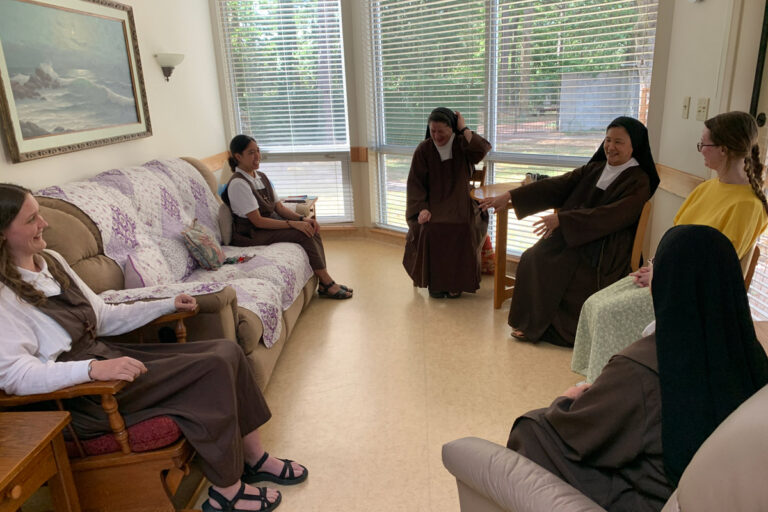
Several young women discerning religious vocations weighed in about the cultural factors that influence vocations — including their own — and the role that the Carmelite Monastery has played in their faith lives.
Theresa Bornhoft, 23, from Little Rock, is a new postulant staying at the Carmelite monastery for the next three months, exploring the vocation.
“I’ve been discerning for several years now, and this Carmel has always been on my heart as a place to come and visit,” said Bornhoft, who arrived at the monastery Sept. 1. “I’ve just been following everyone around and seeing what they do and staying with the Lord in prayer to see if I am supposed to be here for longer … I’m not sure where God is calling me, but I want to find out, and this is a wonderful community to help find out.”
Angelica Dizon, 21, is a postulant originally from North Carolina. She decided to visit the Carmelite Monastery in Little Rock during the COVID-19 pandemic for three months.
“I remember I was leaving, we were driving away, and I felt this ache in my heart,” she said. “It was weird. It was so sudden, too. I felt like God would miss me, like he just wanted me to be there with him. I wanted to respond to that I felt that ache too, like we were both aching. I was like, ‘OK, I promise I’m coming. I’ll come back.’”
Dizon left for three years, discerning her path.
“My prayer was so dry, and it was so painful. I’m supposed to be discerning, and I felt like God dropped me into the dark. … I thought maybe God doesn’t want me … so I went home and to the outside world … got a job and went to a community college and started helping out at the church.”
With a week left until her window to be an aspirant in the monastery ran out, Dizon returned to the Carmelites. She said her friends are happy that she found her calling, but that they’re not as eager to pursue a life of faith.
“I can explain it to them and everything, and a lot of my friends kind of believe in God, like the seed is there, but they don’t really want to go too deep into it,” Dizon said. “It’s more like, ‘I believe that God exists. If that’s what he wants you to do, then go do it.’”
Renee Kendall, 23, another postulant from Wichita, Kan., became Christian at 19 and began attending church with her grandmother, who is a fundamentalist Baptist.
“I started going with her and had an experience in prayer, and I was like, ‘Yes, this is it, God is real and loves me,’” Kendall said. “I had a complete turnaround, a complete conversion at 19.”
When Kendall enrolled in a Baptist Bible college, she grew deeper into the faith.
“I came home for the summer with every intention of going back,” Kendall said. “But instead, I converted to Catholicism.”
When she signed up for RCIA, she found herself drawn to St. Therese of Lisieux after reading her autobiography, “Story of a Soul.”
“I already knew I was called to religious life and that Carmel had to be in it,” Kendall said.
She said many young people fear commitment.
“Something I’ve noticed in a lot of people my age, especially women, after talking to some other young ladies who thought they had maybe be called, is that there’s a lot of fear of commitment in our generation,” she said. “We’re the ‘maybe’ generation … a lot of our generation is paralyzed. You’re just bombarded with everything; there are so many options and ways to go, so they don’t go.”
Sister Cecilia said technology and the pervasiveness of fast and convenient services have also reduced patience and have deterred young people from taking the time needed to discern a religious vocation.
“People are hungering today for something,” said Sister Lucia Ellender, OCD. “They are never going to be satisfied until they find God. … A lot of young people are going to hit rock bottom and start searching for God. … Today, it’s such a whirlwind, and people get stuck. Prayer is the answer to a person’s longing to find God.”
Sister Mercia Mary Bowie, OCD, another sister at Carmel, said pursuing a vocation is like falling in love.
“That’s the only thing that will carry you through any part of the vocation process, just falling in love and doing anything that has to be done in order to keep that love,” she said. “And that’s the only thing that’s going to keep someone persevering. But you can’t do it on your own.”
LR Carmelites pick familiar face as new prioress
written by Katie Zakrzewski |
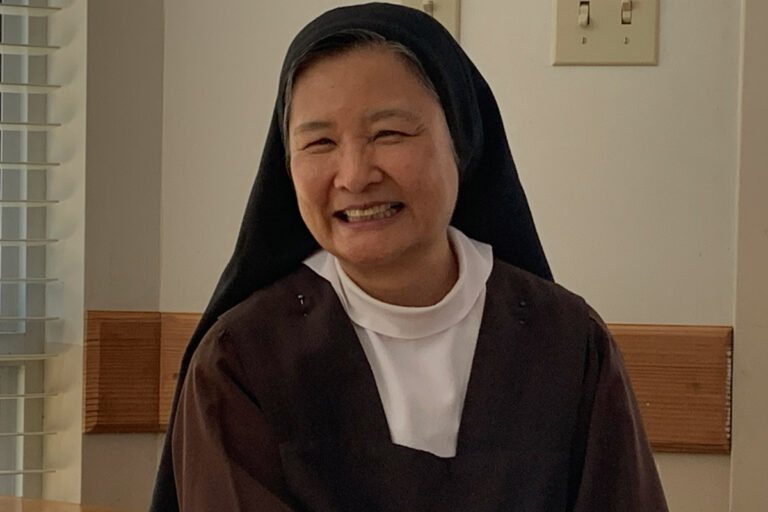
The Carmel of St. Teresa of Jesus Monastery in Little Rock has a new prioress. And while Sister Cecilia Chun, OCD, has served as prioress before, she’s interested in setting an example at the monastery for women’s vocations in a culture with more distractions than she’s ever seen before.
Born in Seoul, South Korea, as the second oldest of five girls, Sister Cecilia moved to the United States with her family when she was 13, settling for a few years in Atlanta.
“At first, I thought, maybe I’m not really adjusting in this world, in a very free country,” she said, recalling how she had to learn English and skip the eighth grade and start high school to make the daily commute easier on her parents.
“But when I was 15 or 16, I was pretty sure that I wanted to be a Carmelite,” she said. “When my parents heard it, they were against it because I was going to graduate at 17 and was going to enter right after. My dad said there was no way — he wasn’t against me being a religious, it’s just that I was too young. My mother said to my dad, ‘This is all your fault — you pray all the time every day and you have five daughters; this was going to happen sooner or later,’” Sister Cecilia said with a laugh.
She stayed at the Carmelite Monastery in Little Rock to complete her three-month aspirancy period, living, working and praying among the sisters before going home and waiting until she could join.
“I think the sisters here thought, ‘Oh, she will not enter with us; she will just get married.’ Meanwhile, I was just waiting and counting the days,” she said.
She spent five years helping with her parents’ business, caring for her younger sisters and researching and visiting religious orders to make sure the Carmelite Monastery was right for her.
After eight years of discerning, Sister Cecilia entered the Little Rock Carmel in 1983 at 23 years old.
“Even though it was a difficult journey, I don’t think I would trade it for anything because I needed all of that time,” Sister Cecilia said. “… I feel really blessed because I got to know our sisters, who were in the first generation because they were here since our foundation in 1950. There are only two or three sisters left since my entrance.”
This is the fourth time that Sister Cecilia has served as prioress at the Carmelite Monastery. The last time was from 2009 to 2015. She has also served as novice mistress, treasurer and council sister.
“It was frightening when it was my first time, but I’ve been here decades,” Sister Cecilia said. “We have a really wonderful community.”
The Discalced Carmelite nuns come from as far away as Panama and India and have established their presence in Little Rock for the past 74 years.
But this time, as prioress, Sister Cecilia has a new concern she wants to navigate as prioress — women’s religious vocations in a tumultuous secular culture.
“We are not getting vocations like we used to back in the 1950s and 1960s especially, but we are still so blessed,” Sister Cecilia said. “Arkansas is not a Catholic state, but still, we were able to maintain 12, 13, 14 sisters. It’s a small miracle, a great blessing and we really appreciate our bishop’s support.”
One of the big challenges facing vocations is all of the distractions of modern life.
“I like to quote Psalm 46: ‘Be still and know that I am God,’” Sister Cecilia said. “I think people who have all of these modern ways of living — they cannot be still, and therefore they do not know themselves. There are so many distractions. The opportunities are there, women can do so much. They have to know why they’re getting into something, what are they going to do in the future, and what are they expecting. They can become confused by these distractions.”
Sister Cecilia said some of these distractions have led young women to seek them out.
“Young people who come to us, that’s part of the calling — they want something very substantial, something real.”
Sister Cecilia compared discerning vocational life to pouring a soft drink.
“It’s like when you pour a Coke, and you’ve got all of the foam and fizz at the top,” she said. “The real drink is on the bottom. Some people spend their whole lives sitting in the foam, and they never reach the real drink. I’m afraid that will go on. The world has its own attractions, and it’s not always real — it’s very confusing and temporary, and some people never find true happiness because of that.”
While the number of women’s religious vocations has fallen across the country in recent decades, Sister Cecilia still finds hope in the allure of the simplistic Carmel life.
“Our order has been around since the 12th century,” she said. “… It’s going to be here forever. What makes us so special is that the lifestyle our forefathers lived is continuing on, and it’s very simple. You give your whole heart to Jesus Christ and practice God’s commandments, love God and love your neighbor in a small community setting. …
“God has to attract and send the young woman here. We cannot do that. We don’t even do any advertisements, but we do help the poor — I would rather spend and show ourselves like that.”
Four men join as seminarians for the diocese
written by Arkansas Catholic Staff |
The Diocese of Little Rock accepted four men as seminarians for the 2024-2025 school year. All four will start with a year of discernment, called a Propadeutic Year. They will live at the House of Formation in Little Rock.
They are:
Matthew Lamb, 18, son of David Thomas Lamb and Jennifer Lamb. He attends Christ the King Church in Little Rock.
Luke Parker, 18, a member of Immaculate Conception Church in North Little Rock. He is the son of James and Vicki Parker.
Parker Vail, 18, son of Thomas and Melissa Ann Vail. He attends Immaculate Conception Church in Little Rock.
Pedro Cervantes, 22, son of Jesus and Amelia Cervantes of Texas. His parish is St. Theresa Church in San Benito, Texas.
Eighteen seminarians are returning. They are:
Deacon Joel Brackett of Rogers is scheduled to be ordained a priest May 31.
Duwan Booker of Little Rock is scheduled to be ordained a deacon May 15.
Tuan Do of North Little Rock is scheduled to be ordained a deacon May 21
Quinton Thomas of Jonesboro is scheduled to be ordained a deacon May 13.
Christopher Elser of Little Rock is scheduled to be ordained a deacon May 24.
Joseph Minh Phong Nguyen of North Little Rock is scheduled to be ordained a deacon May 21.
Phillip Necessary of Rogers
Joshua Osborne of Conway
Sam Stengel of Paris
Ryan Carlson of Van Buren
Benjamin Keating of Fort Smith
Steven Wilson of Stuttgart
Andrew Schaefer of Rogers
Pedro Alvarez of Little Rock
Ngiep Hoang of Weiner
Phillip Zawislak of Little Rock
Jack Smith of Jacksonville
Jesus Tovar of Jonesboro
After 8 years, virgin consecrated at Cathedral Mass
written by Katie Zakrzewski |
Only 5,000 consecrated virgins live in the world, and three of them are in the Diocese of Little Rock.
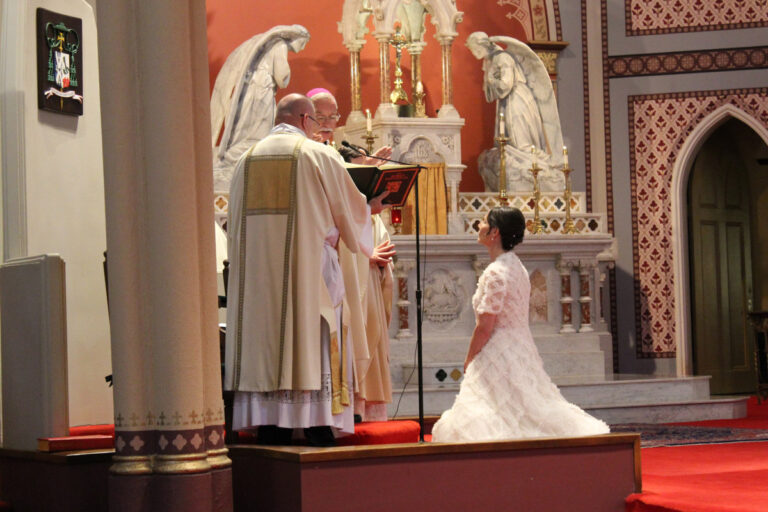
Bishop Anthony B. Taylor blessed the newest consecrated virgin, Mary Kelly, during a Mass July 6 at the Cathedral of St. Andrew in Little Rock. Bishop Taylor noted in his homily that consecrated virgins come from different walks of life. Some are lawyers and firefighters — and some are teachers like Kelly.
Kelly, 47, originally from Wichita, Kan., has a master’s degree in viola performance. In 2009, she moved to Los Angeles and worked at the Pasadena Conservatory in the Suzuki program. While there, a priest told her about a virgin who was being consecrated at the Los Angeles cathedral.
Kelly attended the consecration in 2015 and was struck by the overwhelming importance and beauty of the vocation.
“For me, that vocation was where God was calling me,” she said.
Consecrated virginity is one of the oldest vocations in the Church. Many notable saints from the early Church were consecrated virgins, such as St. Cecilia, St. Clare of Assisi and St. Margaret of Hungary.
Canon 604 states that a consecrated virgin is “consecrated to God, mystically espoused to Christ and dedicated to the service of the Church, when the diocesan bishop consecrates (her) according to the approved liturgical rite.”
Church promulgation for this rite for laywomen came May 31, 1970. When a virgin is consecrated, she renews her promise of virginity to God, vowing that she belongs only to Christ. While consecrated virgins continue to live in the world, they are financially responsible for themselves. They acknowledge the diocesan bishop as their guide and pray for their diocese and clergy.
“The fact that you’re truly marrying Christ, you are a bride — the vocation in itself is that you are the bride of Christ,” Kelly said. “And there’s a simplicity in that. And, as a bride of Christ, your part of that is praying for the Church and praying for your parish, specifically being involved in your parish. In the vocation, you don’t have to do a certain thing within the parish. It’s whatever the Holy Spirit calls you to. And so that’s what I have been doing.”
In 2016, Kelly reached out to the Archdiocese of Los Angeles to start formation, but the diocese was in the process of hiring a new vicar for women religious. She waited two years, talking with a spiritual director to help her start formation.
In the meantime, Kelly began looking for opportunities to move to northwest Arkansas to live near her sister, Jennifer, and her sister’s nine children.
Kelly was attending a music festival in Los Angeles when she met a teacher from Bentonville West High School, who lived 15 minutes from her sister. The teacher encouraged Kelly to apply for a position at the high school as an orchestra director.
In 2019, Kelly moved to Fayetteville; just six months later, the Archdiocese of Los Angeles ended its consecrated virgin program.
“Because they were such a big diocese, they couldn’t vet the women … and make sure they were prepared…,” Kelly said. “So if I had stayed in Los Angeles, this would not have happened. So it’s very clear to me that God knows what he’s doing.”
Kelly, a parishioner of St. Joseph Church in Fayetteville, was sidetracked in her formation again by the COVID-19 pandemic.
In 2022, Kelly reached out to the Diocese of Little Rock to start the process. Her formation director was Dr. Theresa Marshall, a consecrated virgin based in the Diocese of Lansing, Mich. She would meet with Marshall monthly to discuss the vocation, assigned readings and retreats.
Marshall told Arkansas Catholic, “As time went by and (Kelly) became clearer about her call to the vocation as a consecrated virgin, she saw what it means to live in the world as a vessel to bring the love and power of the heart of Christ to the world.
“It is a radical call in a sexualized world dominated by anti-Catholic motives, especially today. The consecrated virgin must be deeply in love with Jesus as he is for us. She must set her heart on Jesus, who has set his heart on her.”
Kelly’s formation took her to many places to visit with other consecrated virgins and observe their lifestyles.
“It’s such a grace that the bishop said yes, that he was willing to do this because it is an unusual vocation,” Kelly said. “And part of living in the world is that I have to take care of myself… You are a bride of Christ, but as a bride, you do have to trust that he will provide.”
In his homily, Bishop Taylor said the vocation of consecrated virgins is important in the Church.
“You may recall that St. Paul declares that women who remain in an unmarried state are free to devote themselves entirely to the things of the Lord,” Bishop Taylor said. “And he alludes to the Church as the bride of Christ … And in this, the Church has upheld the virginity of the Blessed Mother as a model for women who give themselves to the Lord in perpetual virginity.”
For Kelly, the vocation of consecrated virginity has made her feel complete.
“Once I went to that consecration (in Los Angeles), and I saw this woman saying yes to Christ, saying yes to someone in a complete way … that’s what I had desired,” she said. “And I just never felt like I could give a complete yes to someone here. And once I started learning about this vocation and seeing the bridal aspect of it, I started to understand my relationship with Christ in a whole new dimension.”
Understanding Christ’s love through the vocation has also deepened Kelly’s faith.
“Before, I guess I would say that … I understood my relationship with the Father. I understood very clearly my relationship with the Holy Spirit … And with Christ, I’d experienced Christ. But it was like a friendship. … Christ was always there, but … I knew I was missing something in my understanding of my relationship with him.
“And then when I started learning about this vocation and started understanding the spousal relationship and being a bride of Christ, that’s when I was like, now I understand. Now I see that my relationship with Christ is what I’ve always desired.”
Mary Kelly states her intent to become a consecrated virgin, reading from the holy book held by Deacon Chuck Ashburn, and joined by her mentor Dr. Theresa Marshall, during Mass at the Cathedral of St. Andrew in Little Rock July 6. (Katie Zakrzewski)
Mary Kelly comes forward to receive Bishop Taylor’s blessing before lying prostrate in front of the altar during Mass at the Cathedral of St. Andrew in Little Rock July 6. (Katie Zakrzewski)
Mary Kelly lies prostrate in front of the altar before receiving Bishop Taylor’s blessing during the litany of the saints during Mass at the Cathedral of St. Andrew in Little Rock July 6. (Katie Zakrzewski)
Following Communion, Mary Kelly, led by Father Juan Guido, pastor of Christ the King Church in Little Rock, lays her bouquet of flowers at the feet of the Blessed Virgin Mary, pausing to pray before returning to her seat during Mass at the Cathedral of St. Andrew in Little Rock July 6. The bouquet offered by Mary Kelly, seen here, rests at the Blessed Virgin Mary’s feet. (Katie Zakrzewski)